Why does Scroll & Steel use 2d8?

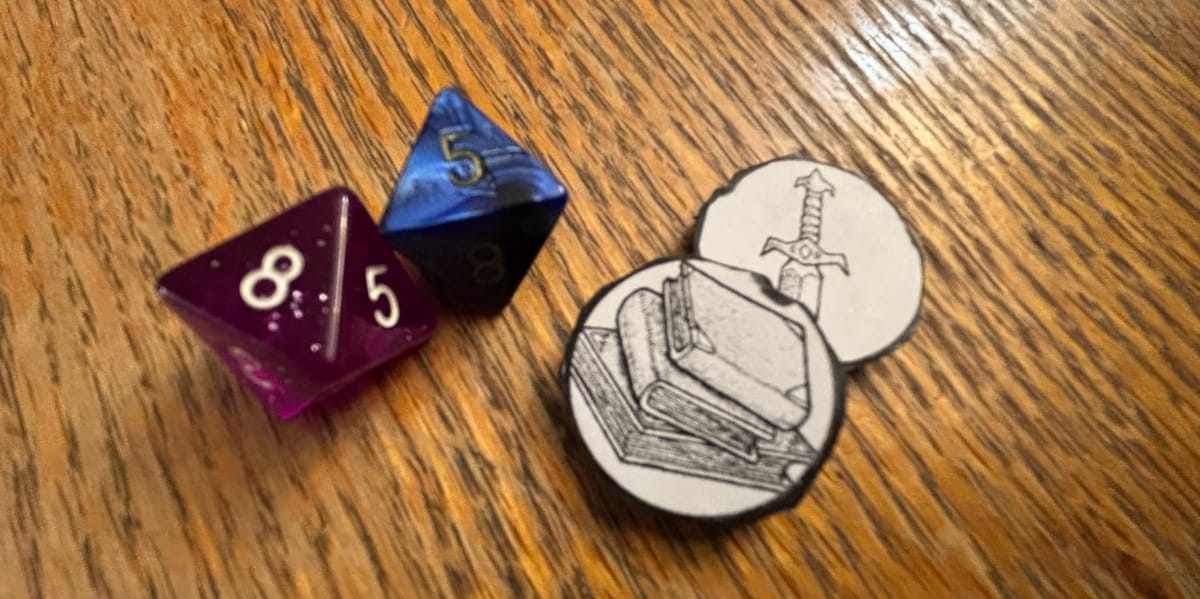
One question I imagine most people will ask about Scroll & Steel when they read it is why in the world does this PBTA game use 2d8. After all, Apocalypse World uses 2d6, and most games in PBTA have followed suit. Given that d6s are much more accessible, it’s an odd choice.
So I figured I’d use this post to detail a bit into why I made this choice and how it ties into my general design ethos for Scroll & Steel.
Background: Why even question this?
The impetus for making Scroll & Steel was, after years and years of playing and designing PBTA games, I finally read Apocalypse World. I was blown away by the text. I thought I knew what PBTA was, but this game completely turned that around and made me realize that the genre had far more potential than I thought.
What I was particularly surprised by were how many elements I thought were critical to PBTA design simply weren’t there. In the same vein, there were many other mechanics that felt critical to PBTA design that felt underrepresented in the various PBTA games I’ve played and read.
I wanted to write Scroll & Steel because I thought there was serious potential for a fantasy RPG that draws more heavily upon the design mechanics specifically from Apocalypse World, not just the mechanics that have made their ways into other games. At the same time, though, I knew that I would have to examine these mechanics in their original contexts, figure out what they do there, and then decide if that’s appropriate for my game. I wanted to draw more heavily from Apocalypse World than other PBTA games, but nothing would be taken arbitrarily.
And on that note, nothing Meguey and Vincent Baker, the authors of Apocalypse World, have written has indicated that 2d6 is core to PBTA design. In fact, they’ve said the opposite (in a really insightful blog post on dice). The fact that 2d6 is so closely tied to PBTA is accidental. So any PBTA game needs to closely examine the 2d6 resolution system and decide if it’s best for their needs.
So first I needed to figure out: what does 2d6 even do?
Examining the 2d6
Apocalypse World and most PBTA games use a 2d6 roll resolution system. When you roll, you roll two standard die (2d6), add your modifier, and check the results. Results are typically broken up into different range bands. Usually how it works is that a seven or more is a “hit” or “success” and a six or less is a “miss” or “failure.“ Also, results of seven through nine are a “mixed success,” which means the player gets a limited success or extra complication. You have to roll ten or more to get a full success.
PBTA games usually use a modifier between -1 and +3 (and maybe with a +/-1 conditional modifier). From my experience running a lot of PBTA games, these numbers feel like:
- -2: Terrible: You feel actively punished rolling this.
- -1: Bad. You only roll this if you’re desperate.
- +0: Meh. Technically the odds are in your favor, but not enough that you can rely on it.
- +1: Fine. It’s perfectly reasonable to roll this and hope for something good.
- +2: Great. You generally feel like an expert at what you’re doing.
- +3: Fantastic. You’re a master of this stat. You can practically plan on getting a full success.
- +4: Beyond fantastic. Rolling with this modifier almost feels like cheating.
Rolling lower than -2 or above +4 would break the game to a certain extent, as this would make one of the range bands completely impossible.
PBTA games typically allow players to get up to a +3 on their own. This is a pretty big power spike, so it’s often gated behind a level requirement or something similar.
So what’s the end result? What does this all mean?
In practice, players typically start off scrappy. Rolling +1 or +2 is usually good, but the chance of a miss is ever-present. Misses in PBTA games hit hard too, often twisting the narrative against the players in dangerous and unexpected ways.
But once players get to that +3, games shift. Rolling with +3 means the conversation is more focused on how they succeed than what they’re risking. And if they can get a +1 bonus to their +3, they basically don’t have to worry about missing as anything but snake eyes will be a success.
In particular, I remember running a Dungeon World session where every single roll was a mixed success or above except one. I don’t remember that feeling particularly odd either.
As you might imagine, this has serious design implications.
2d6 in Apocalypse World
So far, this analysis has been on typical PBTA shenanigans, but now, I want to turn my attention toward Apocalypse World specifically.
What’s notable about Apocalypse World is that it specifically has the Harm move, which uses a different resolution mechanic and stat than most other moves. With the Harm move, you roll +the damage you’ve taken, and you want to roll low. A 10+ result is bad while a 6- result is fantastic.
This move is important because it ties the roll modifier to the damage and harm systems. Apocalypse World has a small harm track. Players have about 6 “hit points,”* and damage is typically 0-3, which is right in line with the standard modifiers.
If, in the new edition of Apocalypse World, the Bakers wanted to use a 2d10 system, this would have implications on their damage and harm systems. Similarly, if they wanted to change the numbers on their damage and harm systems, they’d have to update their roll mechanics.
This goes further too. The harm system ties into the health system which ties into the recovery system which ties into the barter system which ties into the equipment system which, full circle, ties into the harm system. Changing any specific system impacts every other system in some way. For this reason, taking out 2d6 from Apocalypse World is no small feat.
Games inspired by Apocalypse World but that don’t use the same harm system, though, aren’t under the same restrictions.
*This isn’t a very accurate descriptor of the health track but this post is already long enough.
Dice mechanics in Scroll & Steel
Despite my design goals as stated earlier, I actually designed much of Scroll & Steel with 2d6 in mind. However, Scroll & Steel doesn’t use a similar harm move, and so it wasn’t bound to the same restrictions of Apocalypse World. Because of this, I challenged myself to do my due diligence and really determine if these are the best dice for Scroll & Steel.
When reviewing how dice interact in my game, I identified some important factors with how I had the game so far:
- The 3-range band results were providing fruitful design space for interesting moves, so I had no desire to change things up completely.
- Players can evoke bonds they have with other characters to roll with the bond value instead of the normal stat. I really like how the modifier for a bond goes from +1 to +3. This illustrates nicely the mechanical difference between bonds that are new (+1) to developing (+2) to matured (+3). As such, I want to keep similar modifier range.
- Players can also evoke bonds to add +1 to their roll. This means they can pretty easily roll +3 or +4, especially if they’re playing to the strengths of the system.
- Spells in this game rely on a risk/reward balancing. Powerful spells have powerful costs. Certain characters can avoid paying the costs on a partial success, but they can’t avoid the costs on a miss.
With these factors in mind, I began to anticipate problems. If players are able to cast spells with rolling 2d6+4 with any regularity, then they can fairly easily cast powerful spells without worrying about the costs. This limits the design space for spells.
Not only that, but I also didn’t love it when I ran PBTA games and players were able to consistently roll with +3. As I mentioned earlier, it shifts the style of conversation, and I like when PBTA games have a healthy dose of misses.
The end result
Because of those factors, I eventually decided on the following:
- I changed core dice roll to 2d8 instead of 2d6.
- The result bands are now 13+ (full success), 9-12 (partial success), and 8- (miss).
- Stats kept their previous numbers, so the max a stat can be is +3. The same goes for bonds.
- The hard cap on modifiers is +5.
This results in the following changes:
- Rolling with -1 to +2 still is roughly the same as with 2d6. Despite the change in dice, the change in range bands and the normal distribution of these dice kept percentages pretty similar overall.
- Roll with +3 is a bit worse now, almost the equivalent of rolling +2.5. This makes misses a bit more relevant at this stage as you have about a 15% chance to miss instead of an 8.5% chance.
- Rolling with +4 or +5 on 2d8 is about the same as rolling with +3 or +4 on 2d6, respectively. This means that you can still roll with a lot of confidence, but it requires you to have an advantage or use a resource.
This, overall, hits my design goals a lot more squarely. Players can still feel very competent and capable, but how far they can get on their own without playing into the other systems is more limited. Players are more likely to want a little extra oomph to their rolls, even when they’re rolling with their best stat.
To be clear, I don’t think this dramatically changes the game in any unrecognizable way. Really, you could play the game with the standard 2d6 and standard range bands and it would likely still work.
But, as part of my design process, I like to evaluate every single piece of the game and see how it fits into the larger whole. This tweak isn’t the most dramatic, but it’s another mechanic of many that is pushing the game a little bit further into the design spaces I want to explore… even though you have to be a bit of a design sicko to notice the difference.
That’s all for now. If you’d like to download Scroll & Steel, visit the Scroll & Steel itch.io page. If you‘re interested in playtesting the game, sign up on this form.